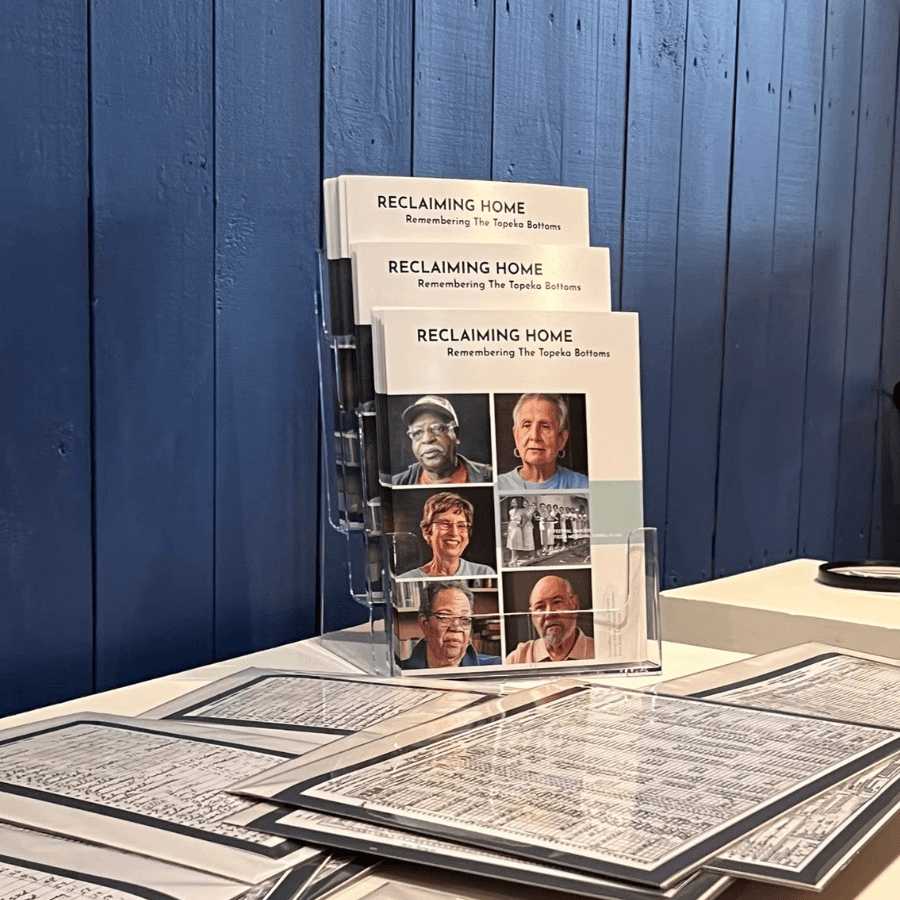
“Reclaiming Home: Remembering the Topeka Bottoms” is a collaborative multimedia project spearheaded by Maria Velasco, Professor of Art of the University of Kansas. It tells the story of the lost Topeka’s Bottoms neighborhood through oral history, a documentary, and art. Velasco partnered with Matthew Jacobson, professor of Film and Media Studies at KU, public historian Valerie Mendoza, and Neill Esquibel-Kennedy, archivist and visiting assistant professor of American Studies at KU to conduct more than two years worth of research and interviews for the project.
The neighborhood, covering more than 20 blocks, was the heart of a thriving Black business district and a Latino community. In the 1950s and ’60s, more than 3,000 Topekans were forced to leave their homes and businesses in the Bottoms district in downtown Topeka to make way for interstate 70 and a new real estate development as part of the Urban Renewal Project. “Reclaiming Home” reveals the stories of these displaced communities at a critical time when the same area undergoes another round of urban renovation.
Although the project began over three years ago, I joined the creative team from February to mid-April 2025 to provide project management support, facilitate internal and external communications, and direct two key events. When I first met Maria, she felt overwhelmed by the project’s delayed timeline and the complex web of interdependent tasks. I knew I could help bring clarity, structure, and momentum to the team.
I began by meeting individually with each team member to understand their roles and responsibilities, clarify tasks, and map dependencies. Using this information, I created a Gantt chart in Google Sheets outlining task timelines, durations, and interdependencies. We reviewed and refined the chart together, identifying opportunities to streamline workflows and reassign tasks for greater efficiency.
It quickly became evident that Maria wasn’t alone in feeling overwhelmed. Communication gaps were hindering progress. To address this, I facilitated weekly team meetings, guided discussions on key decisions and collaborative processes, and followed up with detailed meeting notes and color-coded, prioritized task lists. Between meetings, I provided personalized check-ins to keep team members focused, adapt plans as needed, and maintain strong internal communication.
I also supported external communications by developing content and directing email campaigns, editing and formatting a team-drafted press release, and coordinating news media appearances.
As event director, I led planning and logistics for the exhibition opening at ArtsConnect Topeka (April 4, 2025) and the documentary screening at the Brown v. Board of Education Historic Site (April 5, 2025). This included creating run-of-show documents, researching venues and catering, and managing all event coordination.
I thoroughly enjoyed working on this project. I loved the challenge of helping four very different people, with very different (yet interdependent) sets of tasks stay coordinated. I loved getting to know each team member and their unique support needs! I loved supporting the social justice vision, and voice, of this project across the finish line. My favorite part, of course, was seeing everything come together at the exhibition opening and documentary screening – to successfully execute these events and help the team look their best, despite some bumps and day-of challenges.
Thank you Maria, Matt, Valerie and Neill for the opportunity to be a part of this tremendous project and to help bring the Topeka Bottoms history to life!
The exhibition will be on display at ArtsConnect Topeka through the end of May 2025. You can learn more about this amazing project on the University of Kansas’ Stories for All project page and Facebook.
This project was possible through the generous support of several funders. This project is supported by Stories for All: A Digital Storytelling Project for the Twenty-First Century in partnership between the Hall Center for the Humanities and the Institute for Digital Research in the Humanities at the University of Kansas, and is supported by a major grant from The Andrew W. Mellon Foundation. This project is also generously funded by Mid-America Arts Alliance, the National Endowment for the Arts, and the state arts agencies of Arkansas, Kansas, Missouri, Nebraska, Oklahoma, and Texas. Funding for this program is provided by Humanities Kansas, a nonprofit cultural organization that connects communities with history, traditions, and ideas to strengthen civic life. This investigation was supported by the University of Kansas College of Liberal Arts & Sciences Research Excellence Initiative, the University of Kansas General Research Fund allocation, Scholars On Site, Hall Center for the Humanities, Hall Center Faculty Research Travel Grant, KU Research GO, Office of Research, KU Racial Equity Research, Scholarship & Creative Activity Awards, Arts and Humanities Grant, The Achievement and Assessment Institute (AAI), University of Kansas, Lawrence, KS and TopArts Grant program, ArtsConnect, Topeka, KS.
 Love Move Breathe